The Complete Pool Closing Guide for Hudson Valley Homeowners
How do you close a pool for winter? To properly close a pool for winter: (1) balance water chemistry 1 week before closing, (2) lower water level below the skimmer, (3) blow out all plumbing lines with a commercial compressor, (4) install freeze plugs in all return fittings and skimmer throats, (5) drain and winterize all equipment (pump, filter, heater), (6) add winterizing chemicals (algaecide, shock, stain preventer), (7) install and secure the winter cover.
When Should You Close Your Pool in the Hudson Valley?
The Hudson Valley closes pools later than most homeowners expect — and earlier than most want to admit is necessary.
The target window is when nighttime air temperatures begin dropping consistently below 60°F. In Hudson Valley terms, that's typically late September through mid-October in most years. At 60°F and below, algae growth slows dramatically, which means your winterizing chemistry will hold through the off-season without turning your pool into a swamp.
Why not wait longer? Because the Hudson Valley sees its first hard freezes in October — sometimes earlier at higher elevations in Greene County, Delaware County, and the western Catskill foothills. Water left in exposed plumbing after a hard freeze can crack fittings overnight. You don't get a warning.
Why not close earlier? Because closing a pool in late August or early September shortens your swim season unnecessarily. Water in the pool is still warm enough to support algae growth under a cover, which means your spring opening will require significantly more chemical treatment to recover.
The booking reality: Every year, our pool closing schedule fills up by late September. If you want an October closing — the ideal window — book in early September. Homeowners who wait until the last week of October to call often find themselves unprotected through the first November freeze.
The Complete Pool Closing Checklist
One Week Before Closing — Balance Your Water
This step is done a week ahead because it gives your chemicals time to work and allows you to retest before the actual closing day. Closing a pool with unbalanced water sets up your surface and equipment for a difficult winter.
Pre-closing water chemistry targets:
Parameter
Target
pH
7.2 – 7.6
Total Alkalinity
80 – 120 ppm
Calcium Hardness
175 – 225 ppm
Cyanuric Acid
30 – 50 ppm
Free Chlorine
1 – 3 ppm
The most critical: pH and alkalinity. Water that's too acidic over winter etches plaster surfaces, corrodes metal fittings, and can cause liner degradation. Water that's too alkaline causes calcium scale to form on every surface the water touches.
If you use professional water testing, bring a sample in at least a week before your closing date so you have time to adjust before the closing itself.
Closing Day — Lower the Water Level
For most pool types, lower the water to:
- Below the skimmer opening — so no water sits in the skimmer throat where it can freeze
- Below the tile line for plaster pools — to prevent freeze expansion from cracking tile and grout
- Below the lowest return fitting — to ensure returns drain fully
Do not drain the pool completely. Keeping water in the pool through winter provides hydrostatic pressure that balances groundwater pressure against the pool shell. A completely drained in-ground pool — especially gunite — can actually crack or shift due to frost heave and groundwater pressure during Hudson Valley winters.
Blow Out the Plumbing Lines
This is the most technically critical step of the entire closing process, and the one most likely to go wrong without the right equipment.
Every water line in your pool system — main drain, skimmer lines, return lines, any feature lines — needs to be completely evacuated of water before the first freeze. Water left in PVC plumbing expands approximately 9% when it freezes. That expansion cracks fittings, splits pipes, and can shear unions at the equipment pad.
What you need: A commercial air compressor capable of delivering sustained pressure (rated for the cubic feet per minute your plumbing requires). Consumer shop vacs and small portable compressors are not adequate for this task — they can't fully clear long runs of plumbing or simultaneously handle the volume of a main drain line.
The sequence:
- Set the multiport valve to recirculate (bypassing the filter)
- Blow from the equipment pad through each return line until a strong, steady stream of air bubbles exits the return fitting in the pool
- Once confirmed clear, plug that return fitting with a winter freeze plug
- Repeat for every return
- Blow out the skimmer line — plug the skimmer throat with an expansion plug or Gizzmo
- Blow out the main drain line — leave the main drain valve cracked (do not plug main drains on most pools)
Pro tip: Have someone watch the fittings in the pool while you work the compressor at the equipment pad. You should see strong, sustained air bubbling out before plugging. A weak or intermittent air stream means water is still present.
Drain and Winterize All Equipment
With the lines blown and plugged, every piece of equipment needs to be drained of water:
Pump: Remove the drain plugs (usually two — one on the strainer pot, one on the pump housing). Tilt the pump slightly if needed to ensure all water drains. Store the drain plugs inside the pump basket or in a bag attached to the pump.
Filter:
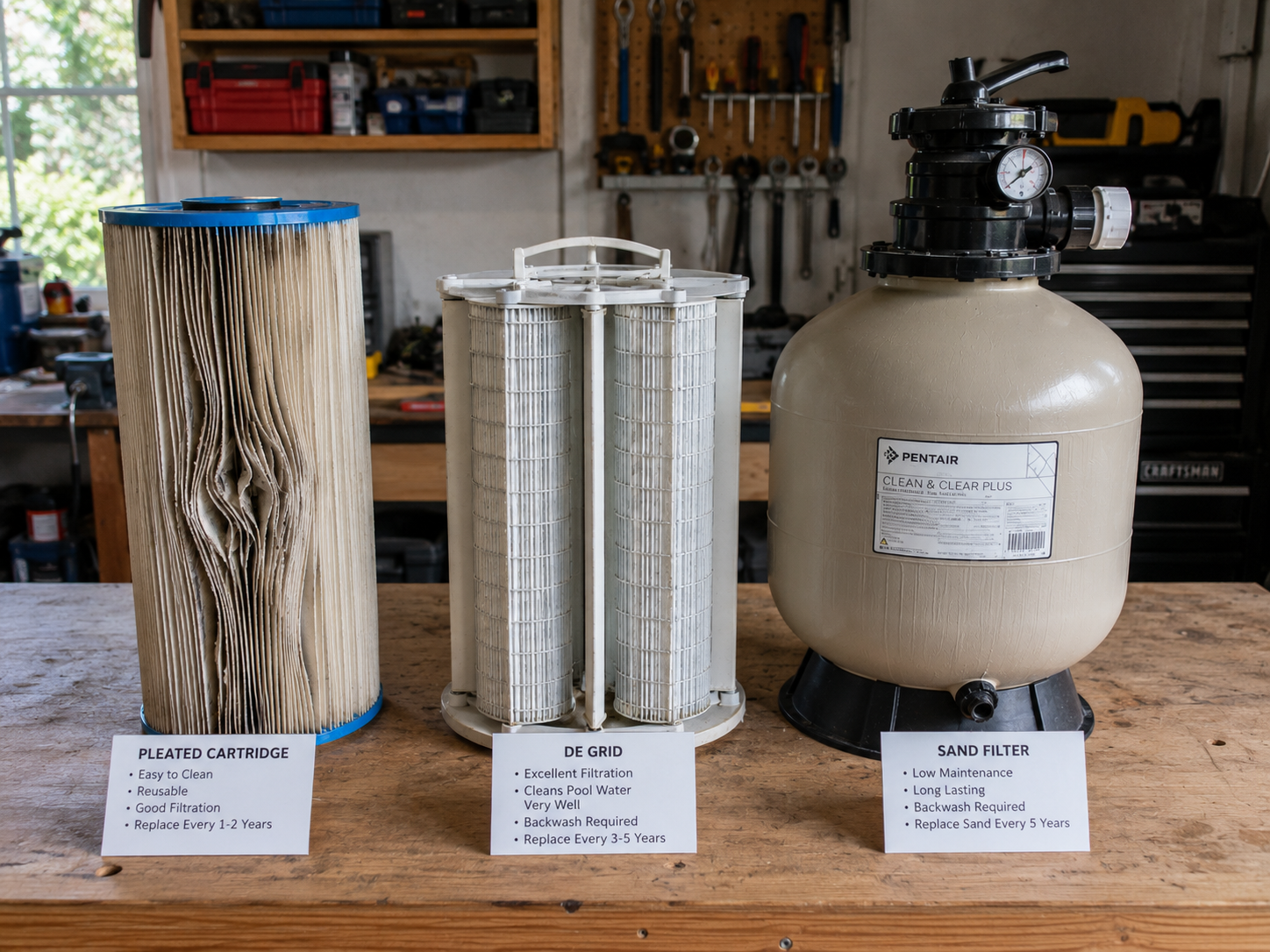
- Sand filter: Remove the drain cap at the bottom and leave open. Set the multiport valve to the winterize position.
- DE filter: Disassemble and remove grids; store indoors or drain thoroughly. Remove the drain plug.
- Cartridge filter: Remove cartridges, clean, and store indoors. Drain the tank and leave the drain cap off.
Heater: Turn off gas supply. Blow out or drain the heat exchanger. Many modern heaters have a built-in freeze protection mode — disable it and fully drain rather than relying on freeze protection, which requires power and may not engage in a power outage.
Chlorinator/salt cell: Disconnect, rinse, and store the salt cell indoors for the winter. Chlorine feeders should be emptied and the housing rinsed.
Automation systems: Power down the controller. If you use a variable-speed pump with a freeze protection program, disable it and cut power at the breaker — freeze protection that requires the pump to run offers no protection when power fails.
Add Winterizing Chemicals
With the pool at the correct water level and the system circulating for a final time, add your closing chemicals in this order:
1. Pool Shock A large dose of calcium hypochlorite or non-chlorine oxidizer to sanitize the water and destroy any organic material before the pool sits for 4–6 months. Use the higher end of the recommended dosage — this needs to last.
2. Winter Algaecide A concentrated, slow-release algaecide formulated for winter conditions. This is different from your regular season algaecide — look for a product with at least 60% polyquat algaecide concentration for effective winter protection.
3. Stain & Scale Preventer Essential for Hudson Valley pools. Our region's water has elevated mineral content — iron, manganese, and calcium — that causes surface staining when water sits still and chemistry fluctuates over winter. A quality sequestering agent binds these minerals and keeps them in solution rather than depositing on your plaster or tile.
4. Pool Antifreeze (if needed) If you have skimmer lines or any lines you couldn't fully blow clear, pool antifreeze (propylene glycol — NOT automotive antifreeze) can be added to those specific lines. Never add antifreeze to the pool water itself — add only to lines that couldn't be fully evacuated.
Let the pump run for 1–2 hours after adding chemicals to distribute them evenly before shutting the system down.
Install Your Winter Cover
The final step. Install your winter cover while the water is calm so it seats properly.
Safety cover (recommended): A mesh or solid safety cover anchored into the deck with springs and stainless steel anchors. Safety covers keep children and pets from falling into the pool, handle snow loads without collapsing, and prevent debris accumulation better than water bag covers. If you don't have one, it's worth the upgrade.
Standard cover with water bags: Lay the cover over the pool, leaving 2–3 feet of overhang on all sides. Fill water bags to approximately 75% capacity (full bags crack when frozen). Position them continuously around the perimeter. Do not use heavy objects on the deck in place of water bags — they damage the coping.
What NOT to do: Don't pull the cover tight. Leaves, rain, and snow accumulation will create a heavy center load that rips a tightly pulled cover. A little slack in the center allows water and debris to pool toward the middle where you can pump it off.
Protecting Your Pool Equipment Through Hudson Valley Winters
The Hudson Valley doesn't just get cold — it gets cold, warms up, freezes again, warms up, and freezes again. The freeze-thaw cycle is more destructive to pool equipment than sustained cold because materials expand and contract repeatedly.
Underground plumbing is your biggest risk. A crack or separated fitting in a buried line may not be visible until spring when you open the pool and notice the pump losing pressure, the water level dropping, or a soggy spot in your yard. Prevention through a thorough blowout is far cheaper than repair.
Equipment pad components — particularly older multiport valves and pump housing — are vulnerable to hairline cracks from trapped water. Even a tablespoon of water left in a fitting is enough to cause a crack when temperatures hit the teens.
Tile and coping are vulnerable when water freezes at the waterline. This is why lowering below the tile line matters — the freeze-thaw cycle working against grout and adhesive causes tile to pop off the wall, usually in the worst possible locations. If your tile is already showing deterioration, the fall closing is the right time to flag it for pool renovation work over the winter.
Pool Closing Timing Reference for Hudson Valley Counties
Different parts of the Hudson Valley region experience first freeze at different times:
Greene County / Delaware County / Catskill region: Higher elevation, colder nights earlier. Target closing by early–mid October.
Ulster County / Columbia County: Classic Hudson Valley timing. Target mid-October closing window.
Dutchess County / Putnam County / Orange County: Slightly warmer. Mid to late October is often fine, but monitor nighttime temps closely.
In every case: book your closing slot before you need it. By the time you're watching the forecast and thinking "I should call about closing," our October schedule is usually booked solid.
Pool Closing FAQ
Q: Can I close my pool myself? A: Yes, if you have a commercial-grade air compressor, know your plumbing layout thoroughly, and are comfortable with chemical dosing. The risk is in what you miss — a single line not fully blown out, a drain plug left in the equipment, or an incorrect cover installation can lead to damage you won't discover until spring. Professional closing includes a written report documenting equipment condition.
Q: Should I add antifreeze to my pool lines? A: Only to lines that couldn't be fully evacuated with air. Do not add antifreeze to the pool water. Use only propylene glycol antifreeze specifically labeled for pool use — not automotive antifreeze, which is toxic to pets and the environment.
Q: What if I wait too long to close and we get a freeze? A: If a hard freeze is forecast within 24–48 hours and your pool isn't closed, prioritize the lines above all else. Shut the equipment down, open the drain plugs on the pump and filter, and get freeze plugs in your returns immediately. A partial winterization done urgently is better than no winterization — then schedule a professional to complete the process as soon as possible.
Q: How do I know if my winter cover is installed correctly? A: The cover should overlap the pool edge by at least 2 feet on all sides. Safety covers should have even tension in the springs — not so tight the cover is drum-tight, not so loose springs pull out. Standard covers should have water bags at every 2–3 feet around the perimeter with no gaps. Water shouldn't immediately be able to get into the pool around the cover edges.
Q: Do you offer opening and closing as a bundle? A: Yes — we offer season packages that include both your spring pool opening and fall closing. Many clients book both in spring so their fall slot is guaranteed. Ask us about seasonal packages when you contact us.
Pool Closing Quick Reference:
- Target closing: when nighttime temps consistently drop below 60°F (late September–October in Hudson Valley)
- Balance chemistry 1 week before closing day
- Lower water below skimmer — never drain completely
- Blow every line with a commercial compressor until confirmed clear
- Drain pump, filter, and heater fully — remove all drain plugs
- Add shock, winter algaecide, and stain preventer
- Secure cover tightly with proper water bags or safety cover anchors