The Complete Pool Winterization Guide for Hudson Valley, NY
How do you winterize a pool in New York? To winterize a pool in New York: (1) balance water chemistry to correct closing parameters, (2) lower water below the skimmer line, (3) blow out all plumbing lines with a commercial air compressor, (4) install freeze plugs in all returns and skimmer throats, (5) fully drain the pump, filter, and heater, (6) add winterizing chemicals (shock, algaecide, stain preventer), (7) install a safety cover or water-bag cover. The most critical step is completely evacuating water from all plumbing to prevent freeze damage.
Why Pool Winterization Matters More in the Hudson Valley Than Almost Anywhere Else
Pool winterization advice written for homeowners in the South or the mid-Atlantic is not the same advice that applies here. The Hudson Valley is not a mild climate. We see sustained periods of sub-zero temperatures, significant snowfall, and — most destructively — the repeated freeze-thaw cycles that characterize upstate New York winters from November through March.
A pool in Florida or Georgia needs winterization. A pool in Ulster County, Greene County, or Dutchess County needs thorough winterization — because the consequences of doing it wrong are significantly more expensive here than anywhere with a mild winter climate.
What freeze-thaw cycling does to pool plumbing: Every time water freezes in a pipe, it expands approximately 9% by volume. When it thaws, it contracts. When it freezes again, it expands again. Repeat this 20, 30, 50 times over a Hudson Valley winter and you understand why a plumbing line that survived one freeze can fail on the fourteenth — even if the initial blowout was done correctly, but incompletely.
What makes the Hudson Valley specifically challenging:
- Significant elevation variation — pools in the Catskill foothills at 1,500+ feet can see sustained temperatures 10–15°F colder than pools in the lower Hudson Valley
- Well water with elevated mineral content that causes accelerated scaling in equipment during temperature swings
- Heavy snow loads that can damage covers, stressed coping, and pool structures
- Extended periods of below-freezing temperatures that don't allow for mid-winter intervention
This guide is written specifically for Hudson Valley pool owners, with the climate realities of upstate New York as the baseline.
Understanding What You're Protecting
Before getting into the checklist, it helps to understand what winter actually threatens in your pool system — because the protection strategies follow directly from the risks.
Plumbing Lines (Highest Risk)
The water inside your PVC plumbing has nowhere to go when it freezes. It expands in every direction — and PVC gives before the water does. Fittings crack at the glue joints. Straight runs of pipe split along their length. Unions separate. Any point where the pipe is constrained — inside a wall, under concrete, at a valve body — is especially vulnerable.
Underground breaks are the worst outcome. A split fitting 18 inches underground doesn't reveal itself until spring, when you start the pump and watch the pressure drop, or notice a wet spot in your lawn that wasn't there before. Excavation and repair of underground pool plumbing in the Hudson Valley routinely costs $1,500–$5,000+ depending on depth and location.
Prevention: Complete line blowout with a properly sized air compressor. Every line. Every return. Confirmed clear before plugging.
Pool Pump (High Risk)
Water in the pump volute (the part that houses the impeller) and the strainer pot will crack the housing when it freezes. The first symptom you'll see in spring is water pouring from the front of the pump housing when you start the system — at that point, you're looking at a new pump.
Prevention: Remove both drain plugs from the pump. Tilt the pump if the mounting allows it. Run air through the pump after the system blowout to confirm it's clear.
Filter Tank (High Risk)
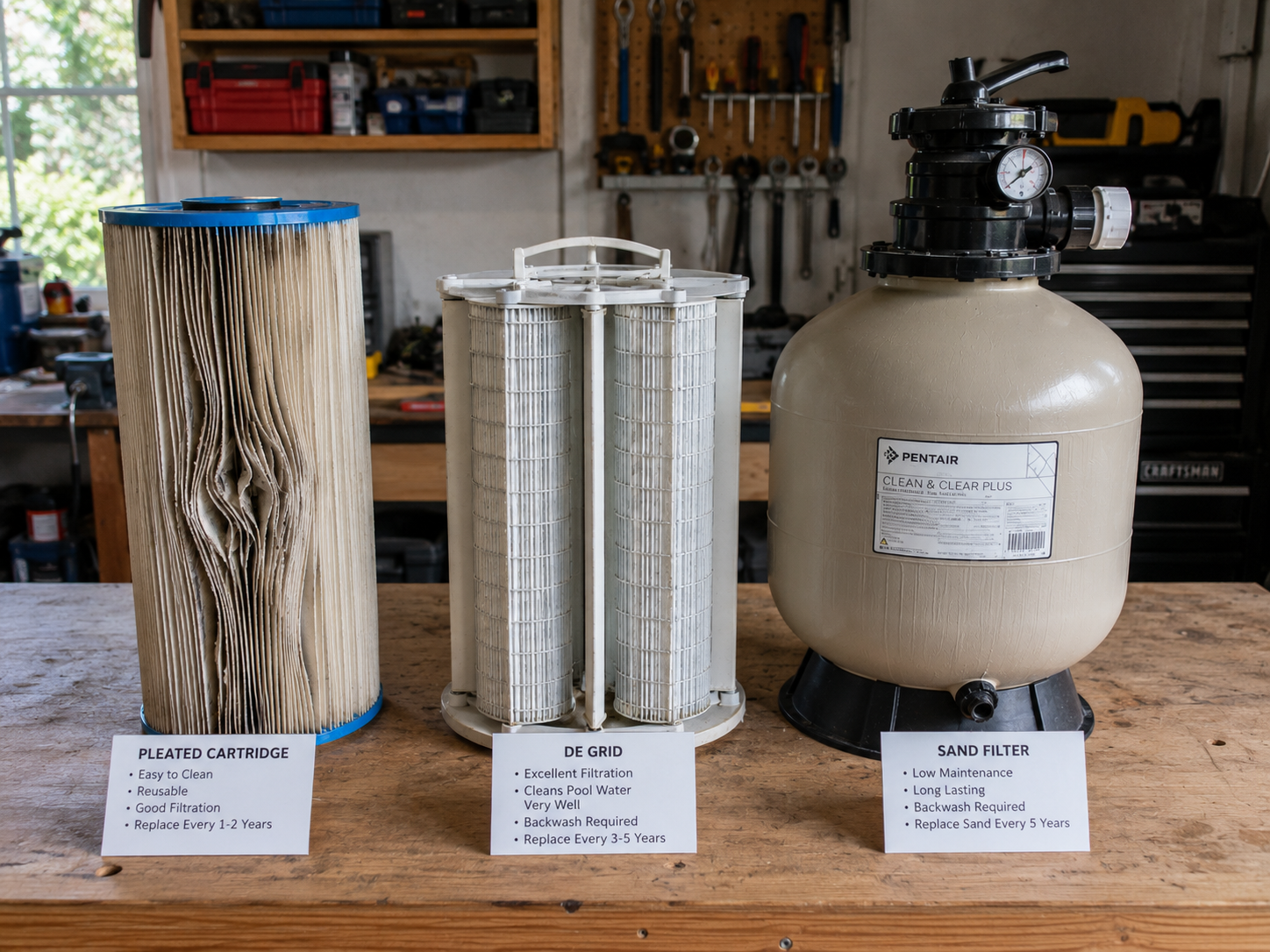
Any water remaining in a sand filter, DE filter, or cartridge filter tank will expand when it freezes. DE filter grids can crack. The tank body can split. Multiport valves are particularly vulnerable — the internal spider gasket and valve body can crack when water freezes inside the valve.
Prevention: Remove drain plugs and leave open. Set multiport to winterize position. Remove and store DE grids and cartridge elements indoors.
Heater Heat Exchanger (High Risk)**
The copper or cupronickel heat exchanger inside your pool heater is a maze of small-diameter tubes that water passes through to pick up heat. Water trapped in these tubes when they freeze creates the same expansion problem in a much more delicate component — and heat exchanger replacement is one of the most expensive equipment repairs on the list.
Prevention: Full drain of the heater, confirmed clear. Consult your heater manual for the specific winterization procedure for your model. Do not rely on freeze protection modes that require electricity — power outages happen in Hudson Valley winters.
Pool Surface (Moderate Risk)**
The pool surface itself is at risk primarily from ice formation at the waterline. When the pool water freezes from the surface down, the ice sheet exerts pressure against the pool walls. Tile grout at the waterline is vulnerable to this pressure — as is the bond between tile and the substrate behind it.
Prevention: Lower the water level below the tile line for plaster pools. Consider using an ice compensator (a floating device that absorbs ice pressure) for added protection. In fiberglass pools, water level can typically remain near normal as the shell flexes slightly with ice pressure.
Cover (Moderate Risk)**
A winter cover that accumulates 12–18 inches of snow is under substantial load. A standard cover that's pulled tight will tear. Water that collects under a sagging cover and then freezes can damage the cover and potentially pull it off completely.
Prevention: Proper slack in the center of standard covers. Safety covers designed to handle snow loads. A cover pump to remove standing water before it freezes.
Pool Winterization by Pool Type
Winterizing a Gunite / Concrete Pool
Gunite pools are the most common type in the Hudson Valley and they're also the most vulnerable to surface damage from improper winterization. The porous nature of plaster means water chemistry during winter directly affects surface condition — water that's too acidic etches plaster while the pool sits.
Key considerations:
- Lower water to 6 inches below the skimmer for most pools; 12 inches below tile line if tile is at or near the waterline
- Pre-closing chemistry balance is critical — gunite surfaces react directly to water pH
- Stain prevention is especially important — mineral content in Hudson Valley water causes iron and calcium staining on white plaster during the off-season
- If your plaster is already showing significant wear, consider pool resurfacing in the spring before reopening
Winterizing a Fiberglass Pool
Fiberglass pools are more forgiving in winter because the shell flexes slightly under ice pressure rather than cracking. However, they're not immune to winterization mistakes.
Key considerations:
- Water level for fiberglass pools should typically remain higher than for gunite — consult your manufacturer's specifications, as many recommend keeping the water level close to normal to support the shell shape
- Fiberglass is non-porous so chemistry has less direct impact on the surface, but unbalanced water still affects equipment and accessories
- Do not use an ice compensator that punctures or stresses the fiberglass surface
Winterizing a Vinyl Liner Pool
Vinyl liner pools are the most sensitive to water level management in winter. The liner needs water to support it — a liner that collapses or shifts over winter due to low water levels may not reseat correctly in spring.
Key considerations:
- Lower water level to just below the skimmer throat — no further for most vinyl liner pools
- Inspect the liner carefully before closing for any tears, lifting at the bead track, or areas of concern that could worsen over winter
- Metal walls behind a vinyl liner can rust if water gets behind the liner — look for any areas where the liner has separated from the wall
The Hudson Valley Winterization Timeline
This is the calendar framework that works for most Hudson Valley pools:
Late August — Start Monitoring Watch nightly lows. Book your closing appointment now — don't wait. October slots fill completely by late September.
First week of September — Confirm Your Booking Your closing should be scheduled by now. Confirm with your service provider.
2 Weeks Before Closing — Equipment Inspection Walk your equipment pad. Note anything that looks worn, is leaking slightly, or making unusual sounds. Address these issues before closing if possible — or at minimum, document them for spring. A pump showing signs of wear that goes through another winter unsupported may not survive to spring.
1 Week Before Closing — Pre-Close Water Chemistry Get a full water test. Adjust alkalinity, pH, and calcium hardness to closing targets. Let the system run to circulate the adjustments before closing day.
Closing Day (Target: When Nights Are Consistently Below 60°F) Full closing process: lower water, blow lines, plug returns, drain equipment, add chemicals, install cover.
Ongoing Through Winter — Cover Maintenance Periodically pump standing water off the cover surface. After major snowfall, clear snow from the cover if loading is significant (more than 12–18 inches). Check that water bag covers haven't shifted or that safety cover springs are still properly tensioned.
Late February / March — Start Thinking About Opening The opening window in the Hudson Valley starts in April for warmer years. Contact us in March to secure your opening slot — spring pool opening schedules also fill fast.
Winterization Mistakes Hudson Valley Homeowners Make (And How to Avoid Them)
Mistake 1: Using an undersized air compressor A shop vac or a small consumer compressor cannot fully evacuate pool plumbing. Lines may appear to be blowing air while still containing water pockets in low spots or bends. Invest in or hire access to a properly rated commercial compressor.
Mistake 2: Forgetting to drain the heater The heat exchanger is the most expensive component to replace and the easiest to overlook. Always confirm the heater is fully drained before closing.
Mistake 3: Relying on freeze protection to do the job Freeze protection systems (built into variable-speed pumps and automation controllers) will run the pump when temperatures drop near freezing — theoretically keeping water moving and preventing freezing. This works only while the power is on. A single overnight power outage during a hard freeze can cause thousands in damage to a pool that relied entirely on freeze protection instead of proper blowout.
Mistake 4: Closing with bad water chemistry Skipping or rushing the pre-closing chemistry balance is the most common reason pools develop staining, scaling, or surface etching over winter. Proper closing chemistry takes a week to do correctly — don't skip it because you're trying to beat a cold front.
Mistake 5: Over-tightening the winter cover A tightly pulled cover has no room to flex under snow and water loading. It tears under load that a properly installed cover with appropriate slack would handle without damage.
Mistake 6: Waiting too long to book The window between "I should probably close soon" and "every service provider in the Hudson Valley is fully booked" is about two weeks in October. If you're thinking about closing, book the appointment immediately.
Pool Winterization Products Guide
Pool Shock for Closing Use calcium hypochlorite shock for the closing treatment — it's more concentrated and longer-lasting than trichlor-based shock. Dose at the higher end of the recommended rate (2–3 lbs per 10,000 gallons minimum for closing).
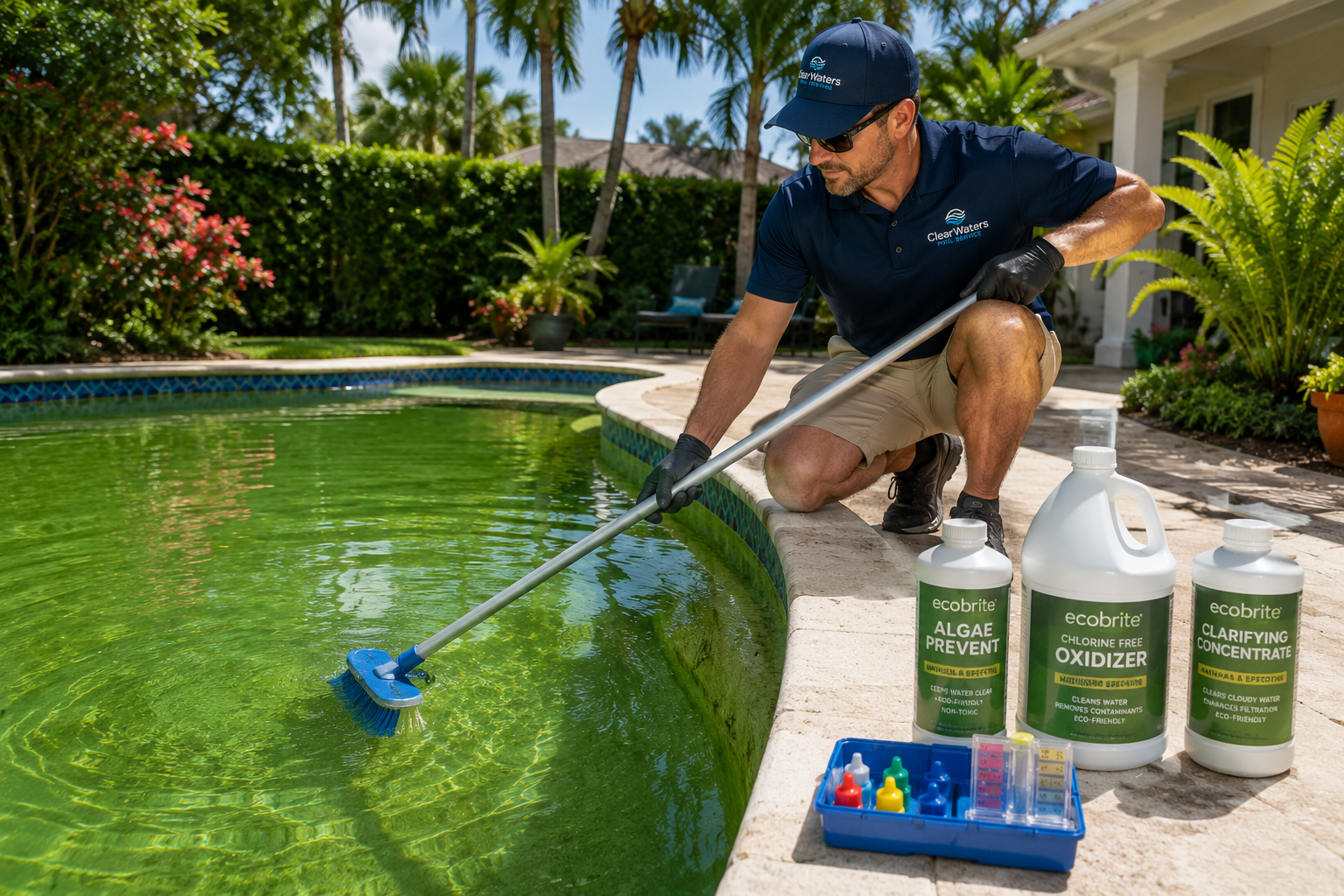
Winter Algaecide A dedicated winter algaecide — not your regular season product — uses a higher-concentration polyquat formula designed to remain effective in cold water and over an extended period. This is not an area to cut corners with a cheaper product.
Stain and Scale Preventer A chelating or sequestering agent binds minerals in the water and prevents them from depositing on surfaces. Especially important for Hudson Valley pools filled with well water or water from systems with elevated iron or manganese.
Pool Antifreeze (Propylene Glycol) Used only in lines that couldn't be fully evacuated by air. Never add to the pool water directly. Use only pool-specific propylene glycol formulations — not automotive antifreeze.
Cover Pump An automatic submersible cover pump that activates when water accumulates on the cover surface. This removes water before it freezes, reducing load on the cover and preventing water from infiltrating around the cover edges.
Ice Compensator / Gizzmo Soft plastic or foam float that sits in the skimmer or on the pool surface to absorb ice expansion pressure. Particularly useful for pools in exposed locations or at higher elevations where sustained sub-zero temperatures are common.
Pool Winterization FAQ
Q: What temperature does pool water freeze at? A: Pool water freezes at 32°F (0°C), the same as regular water. Pool chemicals do not lower the freezing point enough to provide meaningful protection. Saltwater pools freeze at a slightly lower temperature (around 28–30°F depending on salinity), but this difference is not significant enough to rely on for freeze protection in Hudson Valley winters.
Q: Can my pool crack from freezing? A: Gunite pools can develop surface cracks from freeze-thaw cycling, particularly if the plaster has existing hairline cracks. The pool shell itself rarely cracks catastrophically from freezing — the greater risk is to plumbing, equipment, and tile. Fiberglass pools flex and are more resistant to cracking than gunite.
Q: Should I put antifreeze in my pool lines? A: Only in lines that couldn't be fully evacuated with air. Add it directly into those specific lines using a hand pump — not into the pool water. Use only propylene glycol formulations labeled for pool use.
Q: Is it OK to leave my pool open through winter if I run the pump continuously? A: Not recommended for Hudson Valley pools. Continuous pump operation through a Hudson Valley winter requires a freeze protection system, reliable power, and vigilant monitoring. A power outage in January can cause rapid, severe freeze damage. The cost and risk of continuous operation far exceeds the cost of proper winterization.
Q: What happens if my cover collapses into the pool over winter? A: A cover that falls into the pool creates a mess but isn't immediately catastrophic. When spring comes, you'll need to remove the cover and likely deal with significant debris and algae in the water. The more serious risk is if the cover was weighted with something heavy that damages the pool surface on impact. Contact us in spring if your cover situation was problematic — our pool service team handles spring recovery situations regularly.
Q: How do I protect my pool from deer and other wildlife over winter? A: A properly installed safety cover with full deck anchoring prevents wildlife access to the water. Standard covers are not wildlife-proof — particularly from birds and smaller animals. If wildlife access is a concern, a safety cover is the right solution.
Takeaways Box:
Pool Winterization Quick Reference:
- Hudson Valley pools need full, thorough winterization — not minimal steps
- Blow every plumbing line completely clear with a commercial compressor
- Drain every piece of equipment — pump, filter, heater, chlorinator
- Do not rely on freeze protection systems through power outages
- Balance chemistry 1 week before closing, add winter chemicals on closing day
- Book your closing appointment in September — October fills completely
Not sure your pool was properly winterized — or want to make sure this fall's closing is done right? Contact Aqua Jet Pools for professional pool winterization service across the Hudson Valley. We serve Ulster, Dutchess, Orange, Putnam, Columbia, Greene, and Delaware counties. Call us at (845) 481-1494.